Friday, August 7th, 2026
Clinical Research Learning Network (CRLN) and Harbor Launch Hands-On EDC Practice for Aspiring Clinical Research Professionals

Clinical research training often covers the theory but lacks access to the actual software. We've partnered with Clinical Research Learning Network (CRLN) to launch a hands-on practice lab, giving aspiring professionals a safe environment to learn Harbor EDC through real-world, scenario-based trial workflows.

Why this matters
Clinical research training can teach the structure of a study, the responsibilities of different roles, and the language used across a trial. However, access to the software used during that work often comes later, once someone joins a site or begins supporting a live study. The result is that someone may understand what a CRF is and still have little sense of what it feels like to move through visits, enter data, review records, or work inside an actual EDC system.
To help address this gap, we've partnered with Josh Webber and the team at Clinical Research Learning Network (CRLN) to create a "practice lab" for aspiring clinical research professionals.
Josh started CRLN after years working across many facets of clinical research — from the site level to recruitment and everything in between — where he kept seeing the same thing: capable people who wanted into the field couldn't get a foot in the door, and sites couldn't find candidates ready to contribute from day one. His own path was winding 1, so he set out to build the platform he wished he'd had. It's made for career-changers and early-career professionals stepping into coordinator, associate, and administrator roles, and CRLN delivers it in six languages so the door is open to people beyond the usual English-only pipeline. Today, more than 1,200 people are using one of the tools CRLN has built across the platform, spanning 60+ countries.
What he kept hearing was a gap between knowing the vocabulary and knowing the work. Someone could finish a course, explain exactly what source data verification is, and still have never touched the tools a study actually runs on. That's why the practice lab exists. CRLN's clinical research coordinator and clinical research associate tracks drop learners into realistic, scenario-based situations instead of leaving them to pick up the mechanics on the job. Adding a real EDC environment through Harbor was the natural next step: it closes the last part of that gap by letting people work inside the software itself before they ever need to.
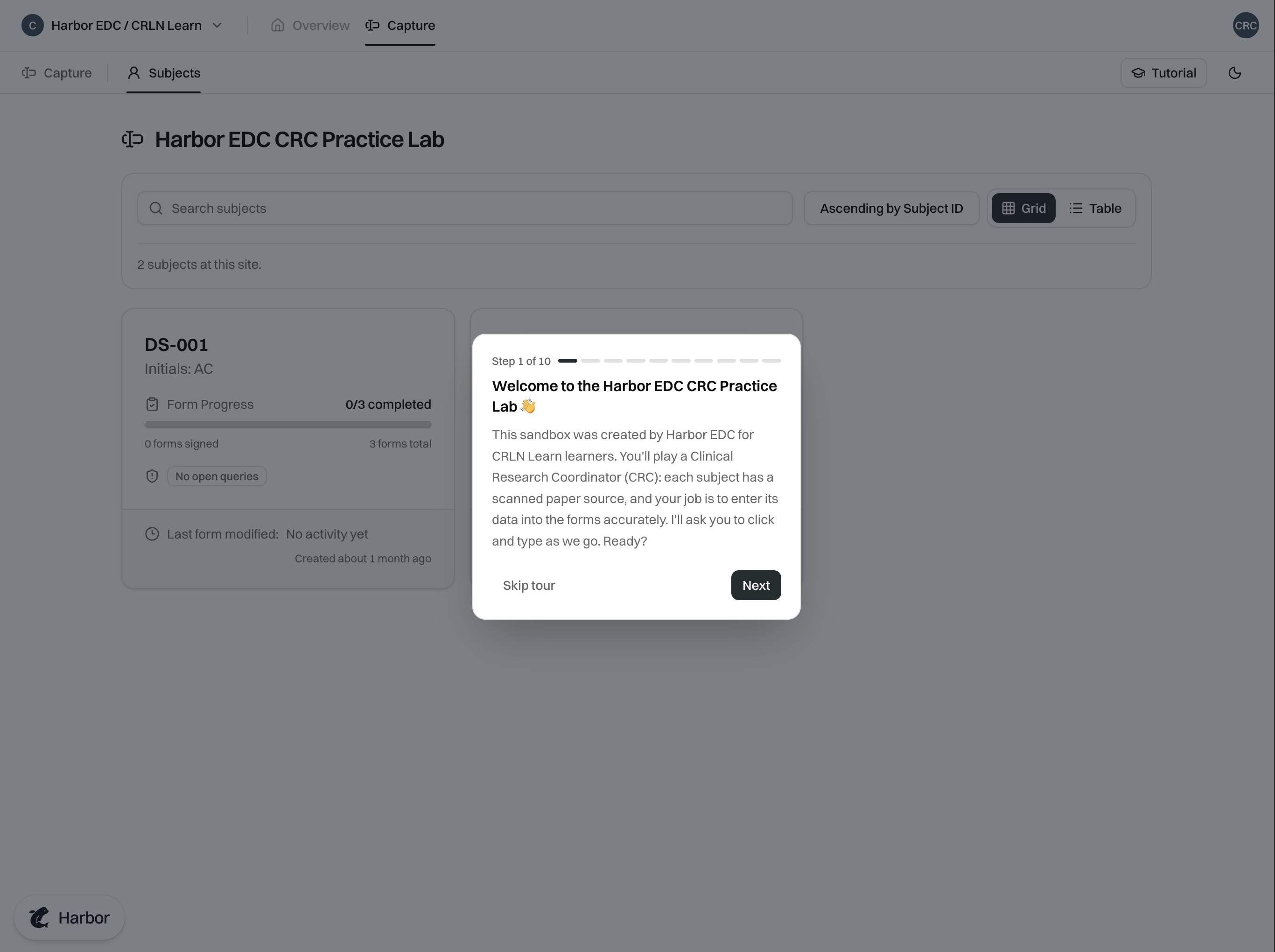
Some screenshots from the CRA practice lab
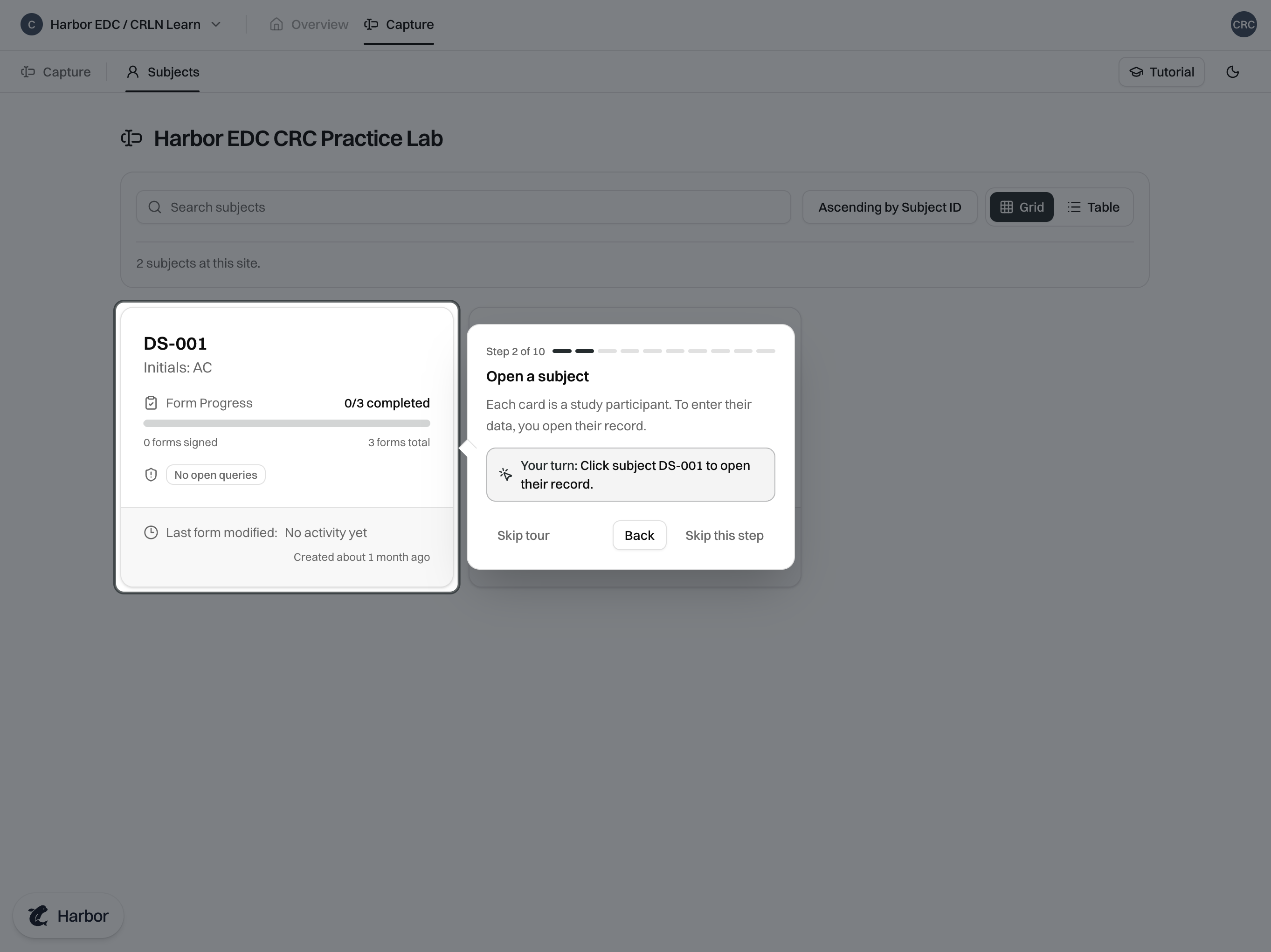
Some screenshots from the CRA practice lab
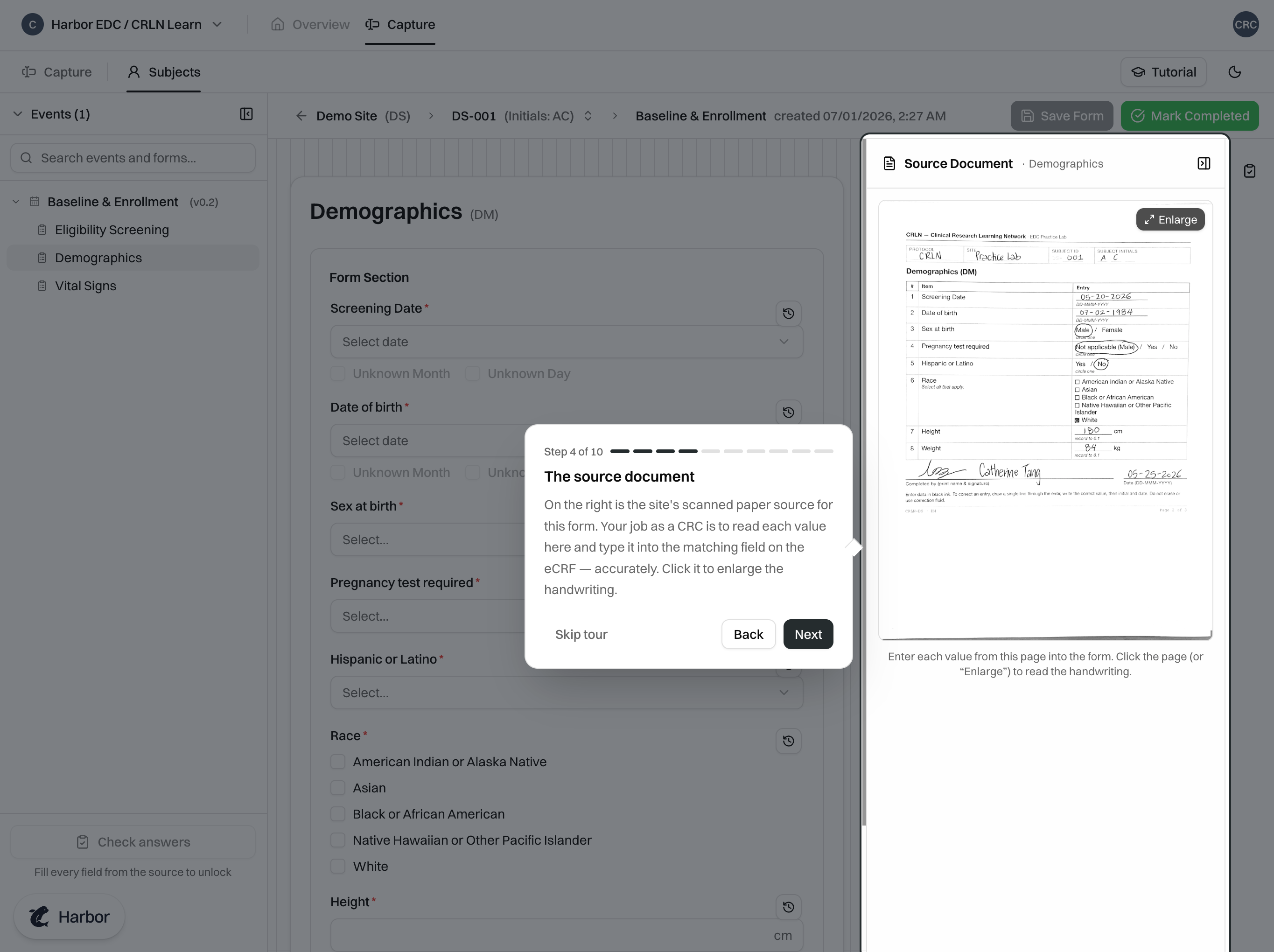
Some screenshots from the CRA practice lab
What we're doing together
The EDC sits alongside the scenarios CRLN has already created for clinical research coordinator and clinical research associate training. Learners can open a mock study in Harbor EDC and work through the interface at their own pace, moving between visits and forms, entering study data, reviewing records, and seeing how information is organized throughout a study, ultimately helping learners build familiarity with the day-to-day mechanics of clinical data collection and monitoring.
The lab is also designed around actual EDC workflows. Learners have tasks to complete inside the study, moving through the system the way a coordinator or monitor would during real study work.2 Because the environment contains mock data, learners can work through the study without affecting a live trial. When they finish, the practice lab checks their work and shows whether they handled the study data correctly.
"You can read about an EDC for months and still freeze the first time a live one is in front of you. Letting new coordinators and monitors move through a real system — enter the data, review the records, catch the issues — before they're responsible for a live study is the difference between someone who knows the theory and someone who's ready to do the work."
— Josh Webber (Founder & CEO, Clinical Research Learning Network)
Footnotes
-
Josh came from a pre-med background and found clinical research almost by accident. ↩
-
This was an important addition. The initial empty EDC sandbox didn't do much beyond show you where the buttons are. The CRLN-Harbor scenarios give you source documents, a role, and something specific you are supposed to accomplish. ↩