Wednesday, March 11th, 2026
Why Traditional EDCs Are Stuck Doing 2-3 Month Manual Builds

Traditional Electronic Data Capture (EDC) systems suffer from months-long manual builds because their outdated, passive architectures rely on tedious human configuration rather than AI automation. To solve this, Harbor EDC was designed with an AI-first approach, eliminating disjointed, error-prone workflows and empowering clinical teams to drastically accelerate their study startup times.
Take a look at any conference agenda, webinar topic, LinkedIn, and you'd think that artificial intelligence (AI) is transforming how clinical trials are run. Integration of AI into traditional clinical research workflows promises to accelerate drug development timelines and to facilitate more efficient and cost-effective clinical trials. We’ve definitely seen AI start to gain some traction in patient recruitment, protocol design, regulatory compliance, and data analysis. But, why hasn’t your Electronic Data Capture (EDC) system been invited to the AI party?
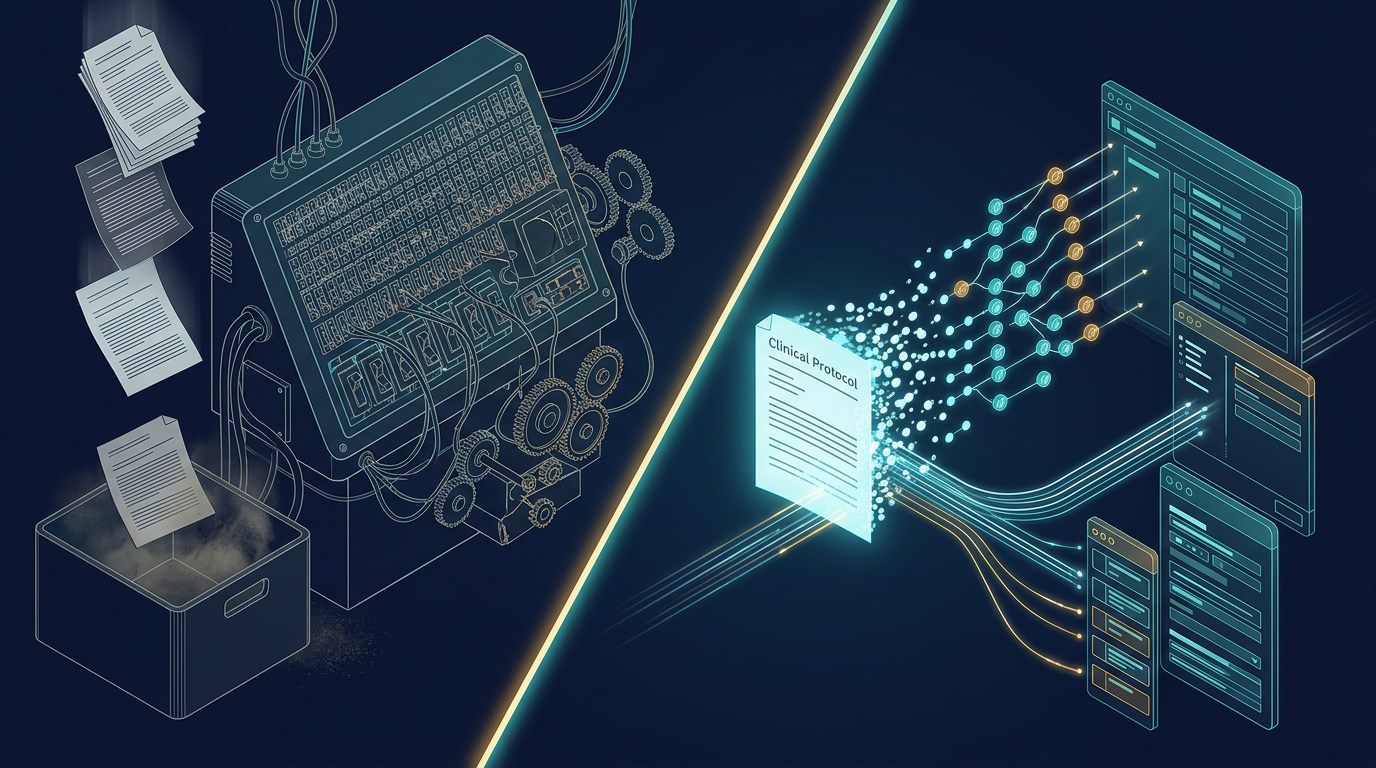
Simply put, traditional or legacy EDC systems weren't built for AI. In fact, today's EDCs are basically compliance wrappers around a basic relational database. The underlying technology has not changed since the early 2000s. With mounting pressure to "integrate AI," traditional EDC vendors are plagued with the decision to either superficially add-on AI features, which prevents clients from harnessing the full potential of AI, or to take the time to re-build their platforms to facilitate AI workflows.1
Here are some reasons why traditional EDCs are stuck in a world where study set up takes months:
- Designed for a thousand clicks. Traditional EDCs were built to be configured, not programmed. They assume a human will manually perform every setup task through the user interface (UI). Creating a study isn't a single action; it's thousands of them: manually building each form, drag-and-dropping every field, typing out every label, and hand-crafting every single edit check and validation rule. To automate tasks effectively, AI agents need high-speed, continuous access to interact with the system. Teaching AI agents to manipulate a UI is known to be slower and more error-prone than allowing them to interact directly through clearly defined APIs. Harbor is built with an easy-to-use UI wrapping around a complete API, which allows both humans and computers to interact with the system easily and consistently.
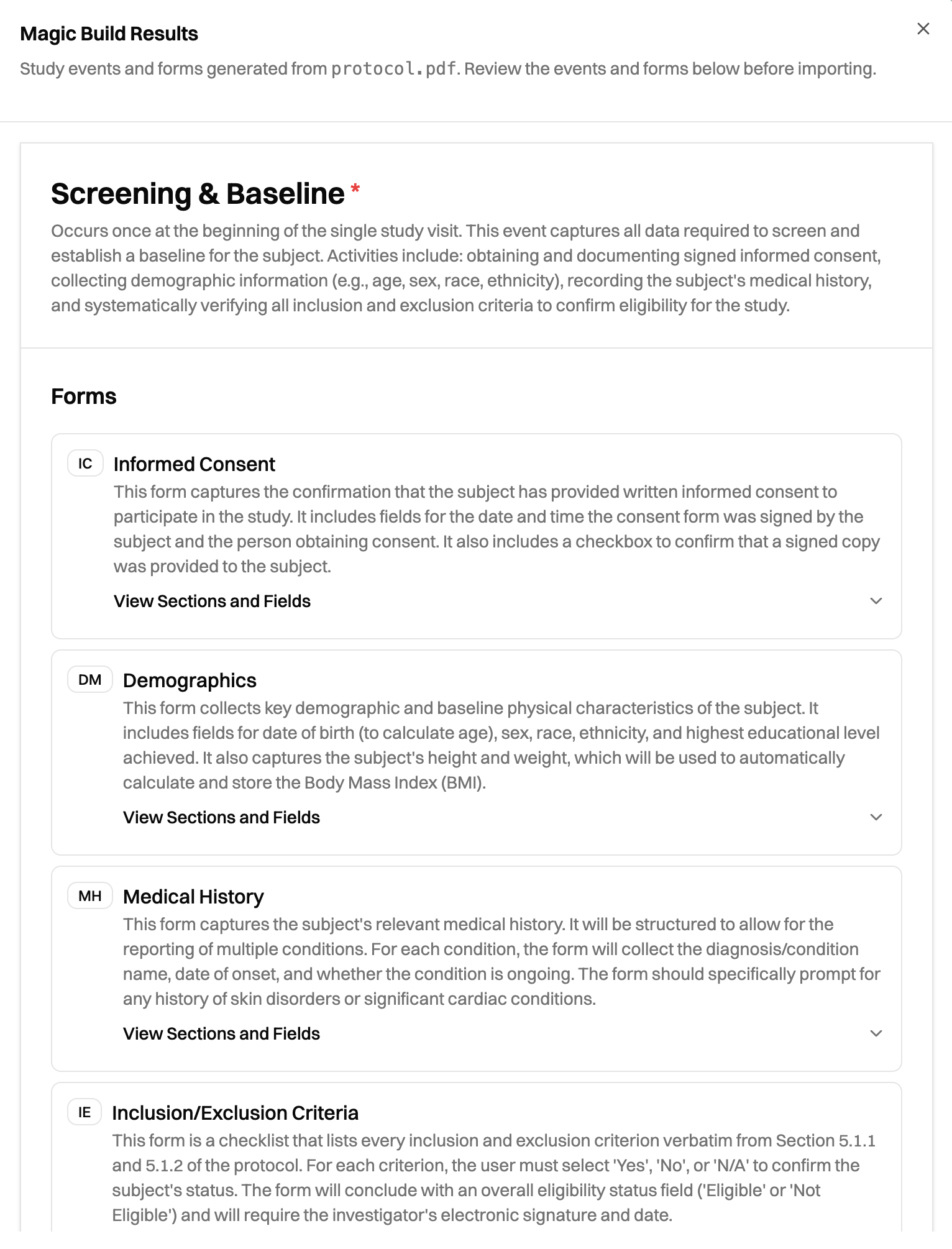
- Passivity. Legacy EDCs are fundamentally passive storage bins that don't actually understand the data being collected. They cannot read or parse a clinical protocol. Instead, a human has to manually translate clinical intent into a custom database schema. Harbor actually reads and understands your clinical trial protocol. Instead of forcing humans to write brittle mapping logic, our Magic Build ingests the protocol directly and compiles the baseline database schema in minutes. This means data managers can spend more time optimizing the build to their specific workflows and needs, rather than spending weeks playing syntax janitor.
- Disjointed, waterfall workflows. Today's EDCs allow users to design eCRFs by hand in isolation. There are no guarantees that the EDC build matches what is specified in the protocol, nor that it matches the source documents. By contrast, Harbor helps build out the study just by reading the protocol, using AI to infer clinical intent and create a full EDC build. Additionally, the EDC build can be directly used to build source documents for sites, ensuring that there are no gaps between the protocol, the EDC build, and the source documents.
What is Harbor's "Magic Build"?
At Harbor, we’re committed to making trials easier, faster, and smarter.
Our entire platform is built with an AI-first approach, prioritizing AI optimization as a core design foundation rather than an add-on feature.
You’ve already heard about our "Magic Capture" tool that uses AI to extract data from source documents to enter data directly into the eCRF. Magic Capture is helping sites reduce the inefficient, manual data entry process and improving data accuracy, all while reducing monitoring costs for our clients.
Another integrated AI tool in Harbor EDC that we’re excited to introduce you to is "Magic Build." By simply uploading a finalized protocol, Magic Build generates your initial database build within minutes. A process that has traditionally taken weeks, or even months, can now be completed in a fraction of the time, with a fraction of the manpower. This generated build serves as a starting scaffold that can then be easily refined within the user interface to meet the specific needs of your study. As with traditional EDC systems, before your database go-live, the build process will conclude with user acceptance testing (UAT) to review all functionality and ensure that data collection kicks off on the right foot from the very first patient visit.
Magic Build also helps to ensure that sites have the tools to collect all necessary data. A full set of source documents (in PDF format) is created for site use based on the protocol and database built in Harbor EDC. Sites can either use these source documents to collect data or use them to help build their own source documents. By linking the EDC build and source document creation processes together, we minimize the risk of any lost data due to procedures or data points being inadvertently omitted from sponsor or site-created source documents.
Our goal with Magic Build is simple: shrink the time it takes to go from protocol to a fully functional study database, accelerating study startup, and helping teams move forward with confidence.
Is it time to switch?
Magic Capture and Magic Build are only the beginning of what Harbor EDC can offer. Because our platform is built with AI at the forefront, we are uniquely positioned to continuously adapt to the evolving AI landscape. As new capabilities emerge, we can seamlessly integrate them into the platform without workarounds, manual passthroughs, or compromises to system integrity. That means our clients will always have access to the most advanced tools, built directly into the systems they already rely on.
We get it, change can be scary. Maybe you’ve been with your current vendor for a long time, you’re comfortable, and you know that at the end of the day, that system works. Or perhaps your team has adapted workflows around an outdated system and the idea of additional changes feels overwhelming. But at some point, it’s worth asking: are you still getting what you need? If your current software is slowing you down, forcing workarounds, or limiting innovation, could it be time to admit that your software-as-a-service is doing you a disservice?
Maybe, it’s time for something better. If you're ready to see how Magic Build and Magic Capture are optimized to help you collect better data in your studies, book a demo with us.