Thursday, April 16th, 2026
Why is 21 CFR Part 11 So Important for Clinical Trials?

Regulatory compliance in clinical trials isn't just about checking boxes: it's about keeping things on track, and preventing cascading delays and costly remediation. Discover what 21 CFR Part 11 actually requires, and why staying compliant is so important for making sure clinical trials run smoothly.
Efficiency matters in clinical trials, but regulatory compliance and data integrity are paramount. To meet government-mandated compliance and integrity obligations, effectively all clinical trials today rely on Electronic Data Capture (EDC) systems to collect and manage study data. But these systems don’t ensure integrity and compliance out-of-the-box. When these systems are used in FDA-regulated clinical research, sponsors, ultimately, must also do the work to ensure they are properly validated and used in a way that supports compliance — most importantly, with 21 CFR Part 11, a federal regulation that regulates the usage of electronic records in clinical trials.
Perhaps surprisingly, the critical consequence of compliance failure isn’t necessarily regulatory scrutiny per se — it’s the cascading delays and costly setbacks related to remediating any unforeseen compliance gaps found, increasing workloads for already resource-constrained teams, and delaying new drugs and devices from making it to market. All things considered, compliance and trial efficiency very much go hand-in-hand.
While the compliance requirements for 21 CFR Part 11 may seem mundane, they exist for a reason: to ensure that electronic trial data are accurate, traceable, and trustworthy. Without it, regulators aren’t able to trust the data. Understanding what Part 11 compliance actually requires can help sponsors (and vendors) prevent operational issues that might otherwise surface later in a trial while also avoiding superfluous compliance ceremony. In brief, the compliance measures outlined in 21 CFR Part 11 include:
-
Audit trails. Every change in trial data must be recorded and traceable. This functionality almost always comes with the EDC, although the quality and ease of accessing these audit logs from within each system varies.
-
User access controls. Each user must have a unique login and permissions to view and modify data based on their specific role. This is also provided by the EDC system, but some EDCs give you more granular control and visibility than others.
-
Electronic signatures. Act as legally-binding equivalents of an individual’s handwritten signature. This functionality is also provided by the EDC, but must conform to very precise requirements to be considered valid.
-
System and study build validation. Proof that EDC system software works consistently and as-intended — including specifically for the sponsor’s study. Depending on the EDC, the sponsor- and study-specific validation process may be very easy or somewhat of a challenge.
Remember: compliance responsibility ultimately rests on the trial sponsor! Amid the many operational demands of launching a trial as an early-stage biotech or medtech company, compliance may initially be seen as a “check-the-box” exercise and not as a critical part of study operations, which can cause issues to surface late in a study when teams are preparing to finalize their data. Luckily, it is easy to be proactive in ensuring your Part 11-compliance.
How startups can reduce compliance risks
Taking a few simple steps early in your trial setup goes a long way in reducing compliance risks later on, and keeping your study on track.
- Always choose an EDC vendor whose system is fully Part 11-compliant, and who can provide audit-ready validation documents on-demand.
- Properly validate systems before study start, and choose an EDC vendor whose systems have first-class support for running user-acceptance testing and other standard pre-study validation processes.
- Maintain clear audit trails and documentation, and make sure the EDC system you choose makes the audit trails easily viewable and accessible.
- Conduct internal compliance checks early.
Overall, committing to using an EDC system which supports full Part 11 compliance — like Harbor — makes it easy for sponsors to both understand compliance and meet all the Part 11 requirements.
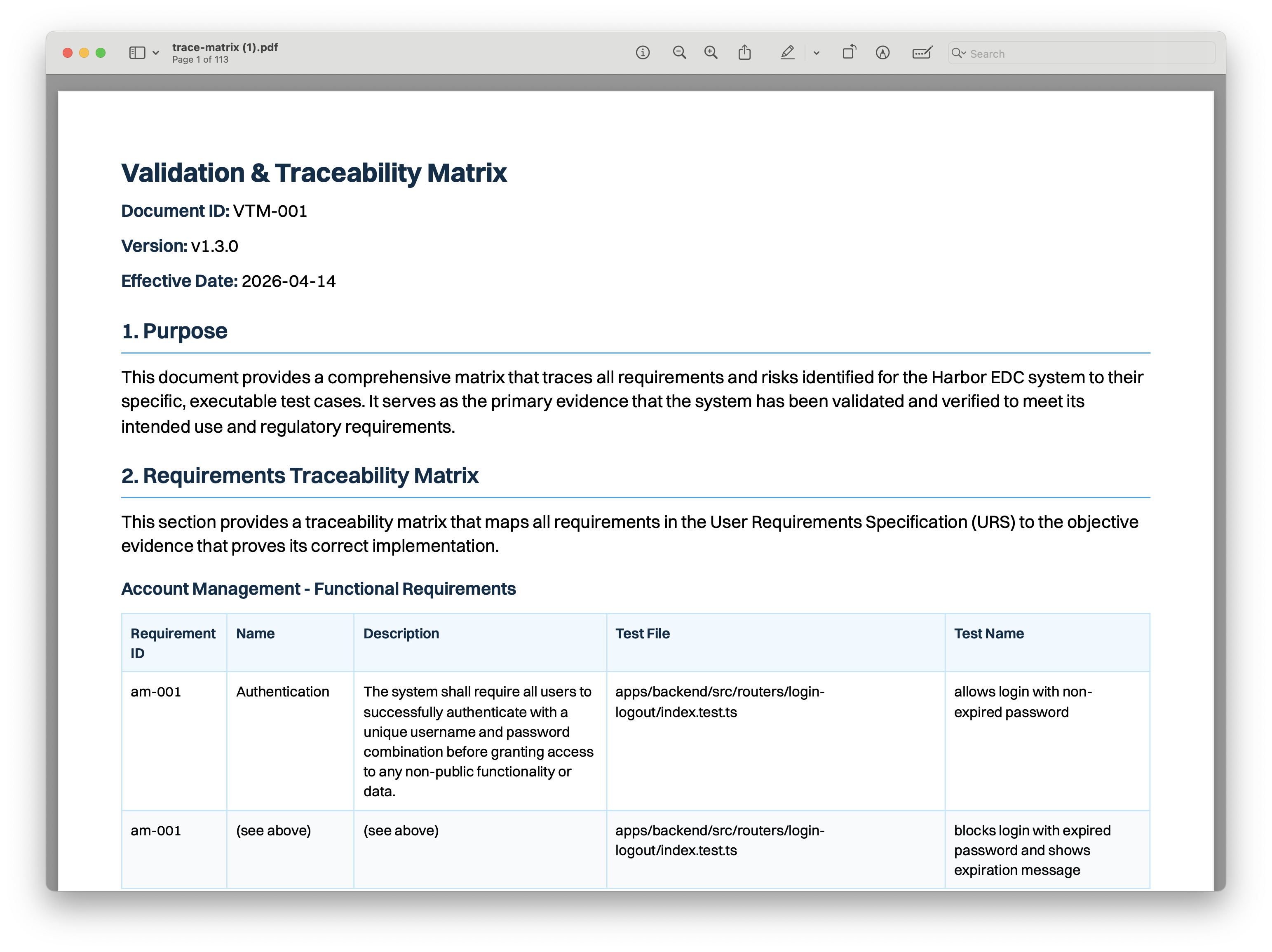
Harbor offers on-demand access to comprehensive validation docs and can instantly generate user-acceptance testing materials for each iteration of your study build, which means you can be proactive in meeting compliance obligations.
The margin for delay in drug and device development is thin. Clinical trials already demand significant time and capital, and operational setbacks can quickly add pressure to both timelines and budgets. Making sure electronic systems meet the requirements of 21 CFR Part 11 isn’t just about regulatory box-checking — it’s about keeping trials moving. When an EDC system is built from the ground up to help trial sponsors stay audit-ready from the very start, sponsor teams are more likely to have an on-time, on-budget, and successful trial.
Harbor was built from the beginning to meet the requirements of Part 11, and makes it easy for sponsors to stay compliant. If you’re running a trial soon and want to learn more about Harbor’s automatic validation package generation and sponsor-friendly compliance features, schedule a demo today.